Abstract
Beyond the commonly recognized optical aberrations, the imaging performance of compact optical systems—including single-lens and metalens designs—is often further degraded by veiling glare caused by stray-light scattering from non-ideal optical surfaces and coatings, particularly in complex real-world environments. This compound degradation undermines traditional lens aberration correction yet remains underexplored. A major challenge is that conventional scattering models (e.g., for dehazing) fail to fit veiling glare due to its spatial-varying and depth-independent nature. Consequently, paired high-quality data are difficult to prepare via simulation, hindering application of data-driven veiling glare removal models. To this end, we propose VeilGen, a generative model that learns to simulate veiling glare by estimating its underlying optical transmission and glare maps in an unsupervised manner from target images, regularized by Stable Diffusion (SD)-based priors. VeilGen enables paired dataset generation with realistic compound degradation of optical aberrations and veiling glare, while also providing the estimated latent optical transmission and glare maps to guide the veiling glare removal process. We further introduce DeVeiler, a restoration network trained with a reversibility constraint, which utilizes the predicted latent maps to guide an inverse process of the learned scattering model. Extensive experiments on challenging compact optical systems demonstrate that our approach delivers superior restoration quality and physical fidelity compared with existing methods. These suggest that VeilGen reliably synthesizes realistic veiling glare, and its learned latent maps effectively guide the restoration process in DeVeiler. All code and datasets will be publicly released at https://github.com/XiaolongQian/DeVeiler.
Method
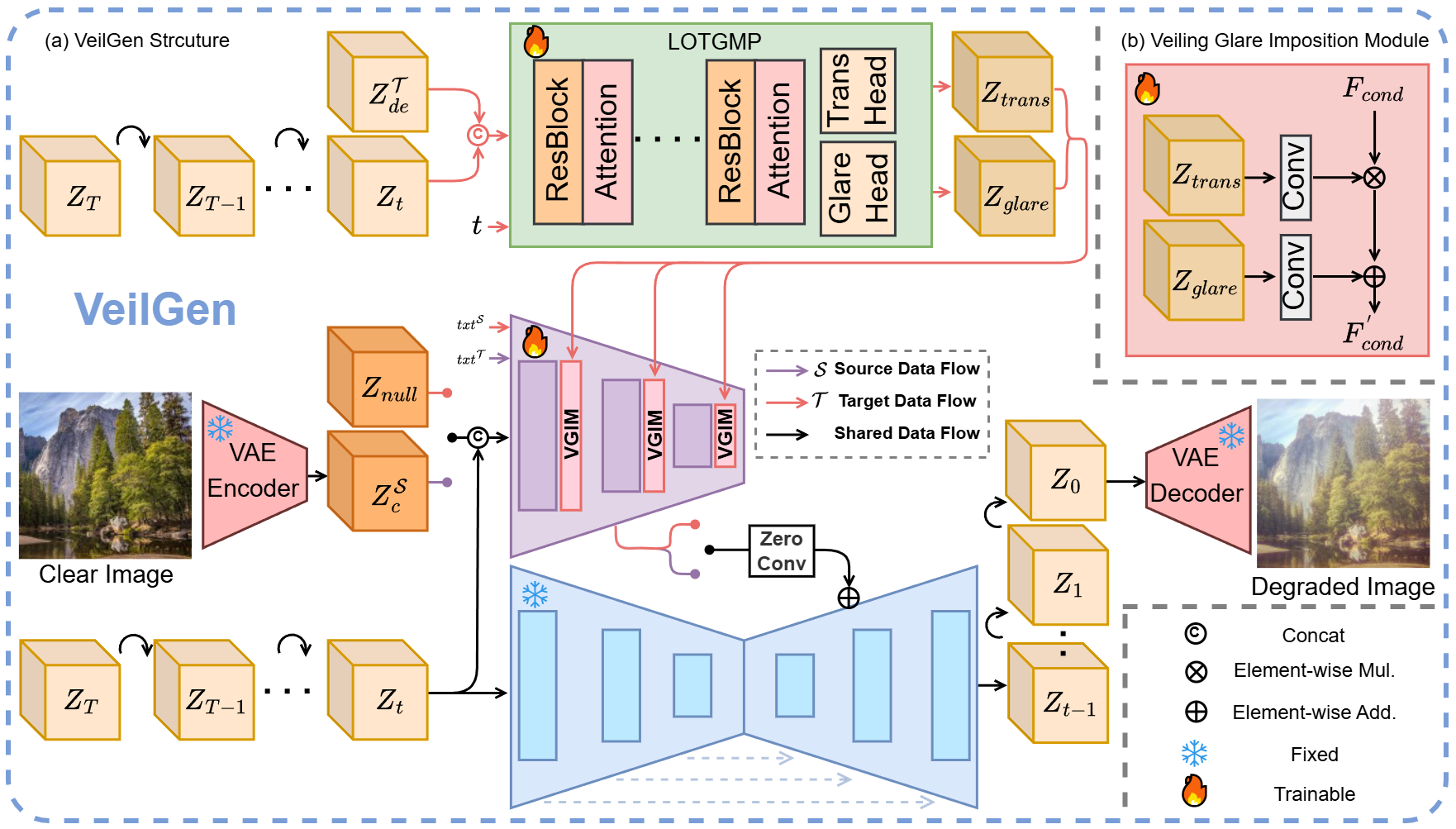
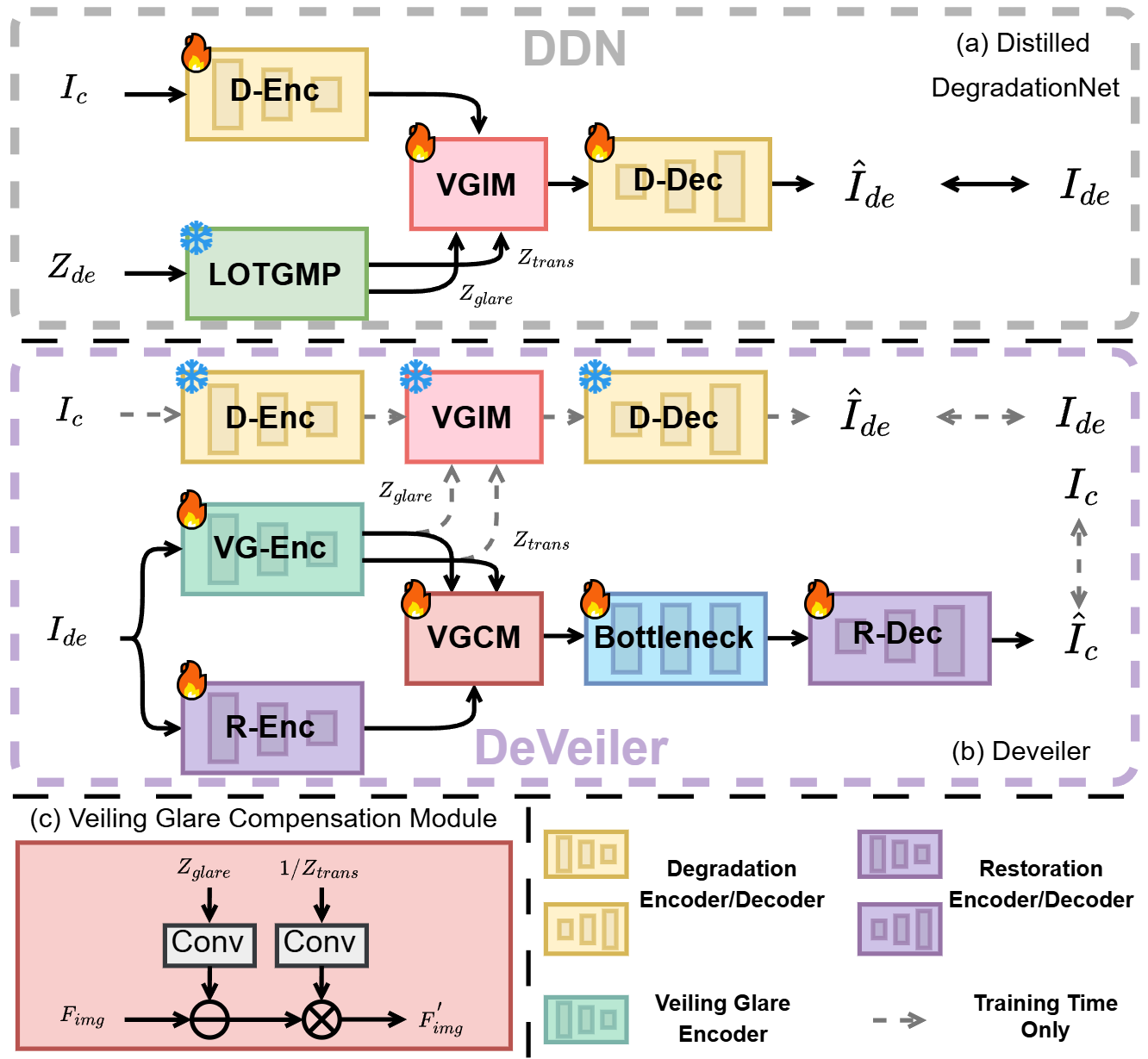
Our pipeline contains a generative degradation module, VeilGen, that synthesizes compound aberrations and veiling glare, and a restoration network, DeVeiler, that leverages the learned priors to invert the degradation. The figures below summarize both components.
Results
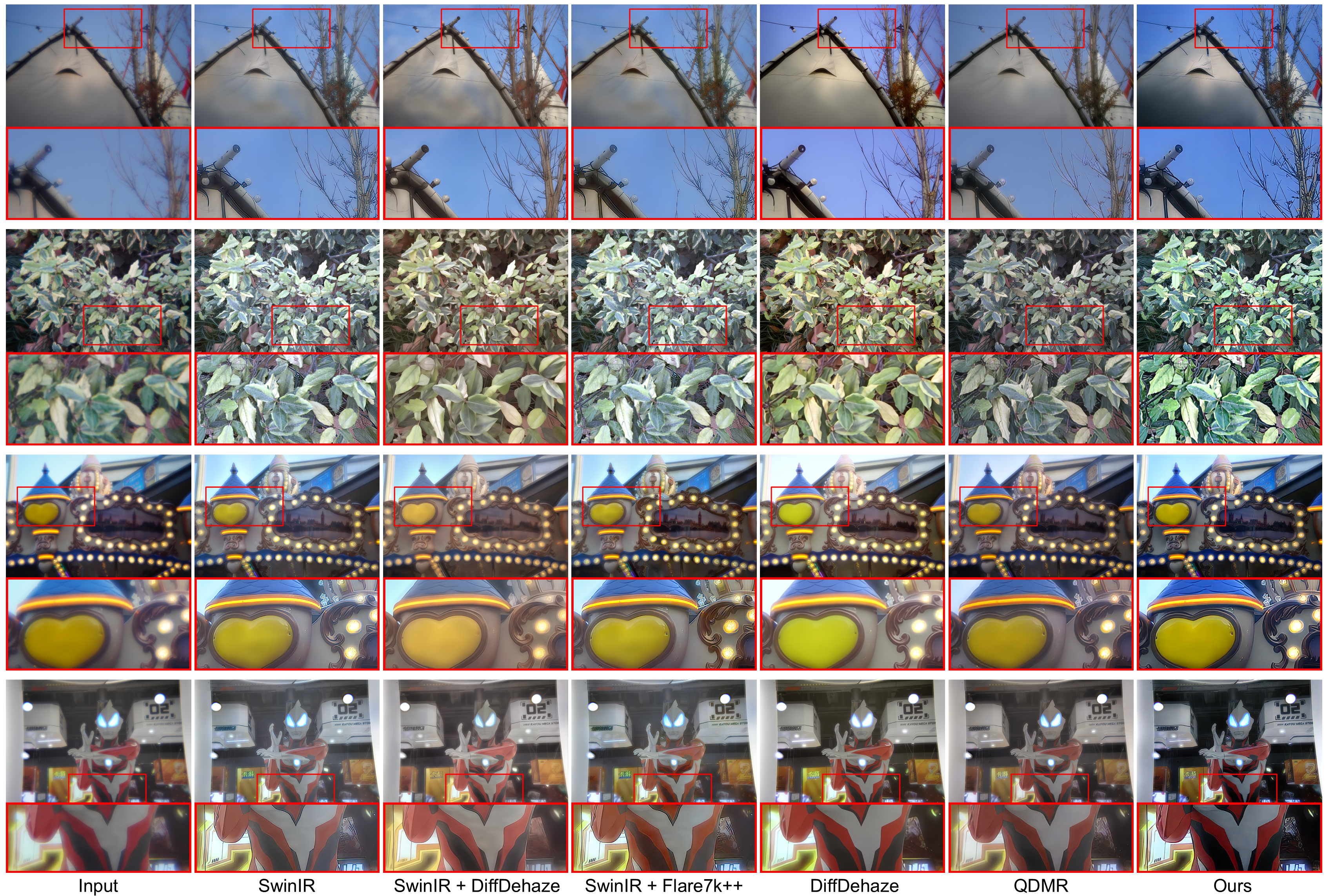
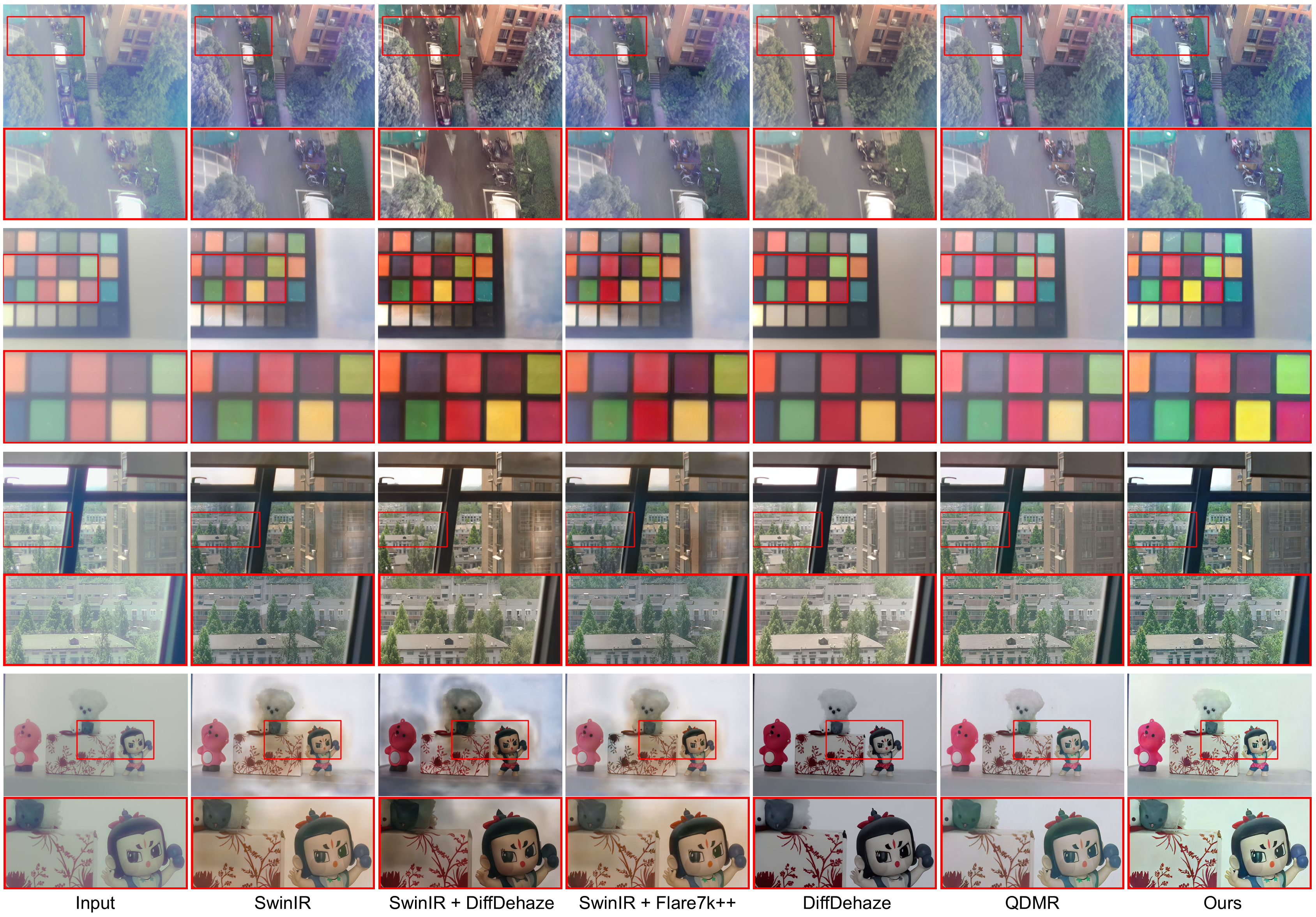
DeVeiler consistently restores contrast, suppresses spatially varying veiling glare, and preserves scene details across real-world compact optical systems. The qualitative comparisons below show representative results on single-lens (SL) and metalens-related (MRL) captures under compound degradation.